1. Introduction
What is Nano-SuperCaps?
Nano-SuperCaps is a research and innovation project focused on the development of high-performing structural supercapacitors free of critical raw materials.
The project explores multifunctional composite structures that combine mechanical performance with electrical energy storage, with the aim of developing lighter and more space-efficient solutions for future transportation and other weight-sensitive applications.
Structural Supercapacitor Concept
A structural supercapacitor combines two functions within the same component:
- Structural function - providing mechanical strength and integrity.
- Energy-storage function - storing and delivering electrical energy.
Instead of using a separate energy-storage device alongside a structural component, Nano-SuperCaps investigates how energy-storage functionality can be integrated directly into the composite structure.
Introduction to Technology
Nano-SuperCaps investigates a multilayer composite approach combining carbon fiber, conductive nanofibers, a separator, and a polymer electrolyte matrix to create structural supercapacitor components.
The project focuses on developing and integrating these material functions so that the resulting composite can contribute to both mechanical performance and electrochemical energy storage.
The technology is being developed and evaluated through material development, electrode development, composite integration, and mechanical and electrochemical testing.
2. Understanding Structural Supercapacitors
Conventional vs. Multifunctional Composites
The automotive and aerospace industries rely heavily on composite materials because of their high strength-to-weight ratio and stiffness. At the same time, the increasing electrification of transportation creates a growing demand for lightweight energy-storage systems.
In conventional designs, batteries or supercapacitors are installed as separate components within a vehicle or structure. Although this approach provides energy-storage functionality, the additional components contribute to overall system weight and occupy valuable space.
Multifunctional composites offer an alternative approach. Instead of treating the structural material and energy-storage system as separate components, structural energy storage seeks to integrate both functions into a single material system.
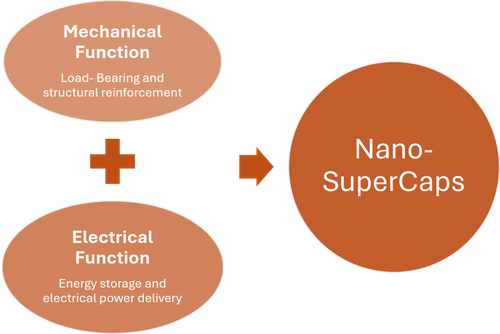
Multifunctionality, Mechanical and Electrical functions
Capacitors vs. Supercapacitors vs. Batteries
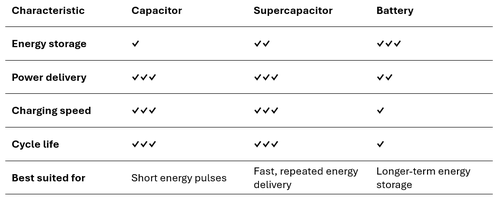
Capacitors, supercapacitors, and batteries all store electrical energy, but they differ significantly in how they store and deliver it. Conventional capacitors provide very high power and extremely fast charge and discharge, but store relatively little energy. Batteries offer much higher energy density but typically have slower charge and discharge rates and shorter cycle life. Supercapacitors bridge the gap between the two, combining high power, rapid charging and discharging, and long cycle life with greater energy storage than conventional capacitors. The comparison below highlights these differences.
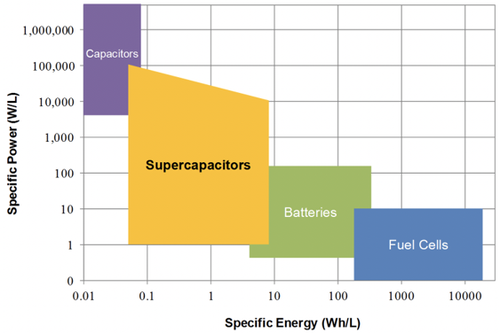
Specific power vs. specific energy for capacitors, supercapacitors, batteries, and fuel cells
What makes a Supercapacitor Structural?
In a conventional supercapacitor, the electrodes, electrolyte, separator, and casing are primarily designed for energy storage. In a structural supercapacitor, these components must also contribute to the mechanical performance of the overall structure.
Within Nano-SuperCaps, carbon-fiber-based materials can provide structural reinforcement while also serving as electrically conductive electrode components. Electrospun nanofibrous materials and conductive nanomaterials are investigated to enhance electrochemical functionality, while polymer-based electrolyte systems provide ionic transport between the electrodes.
The challenge is therefore to achieve a balance between mechanical performance, electrical conductivity, ionic transport, energy-storage capability, and manufacturability.
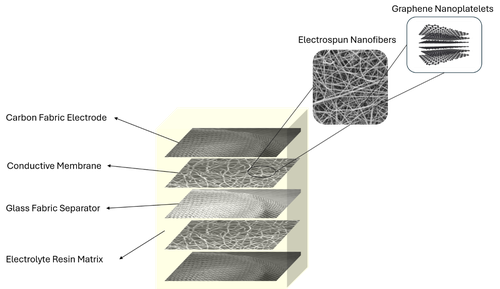
Nano-SuperCaps Supercapacitor layout
3. Materials and Technology
Nano-SuperCaps combines advanced composite materials, conductive nanofibrous materials, and polymer-based electrolyte systems to develop multifunctional structures capable of providing both mechanical performance and electrical energy-storage functionality.
Press a card to reveal the novelty of each material
Cards:
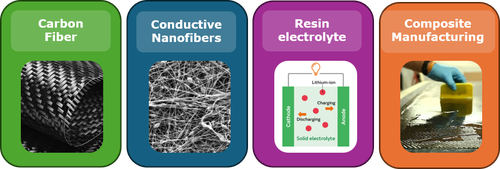
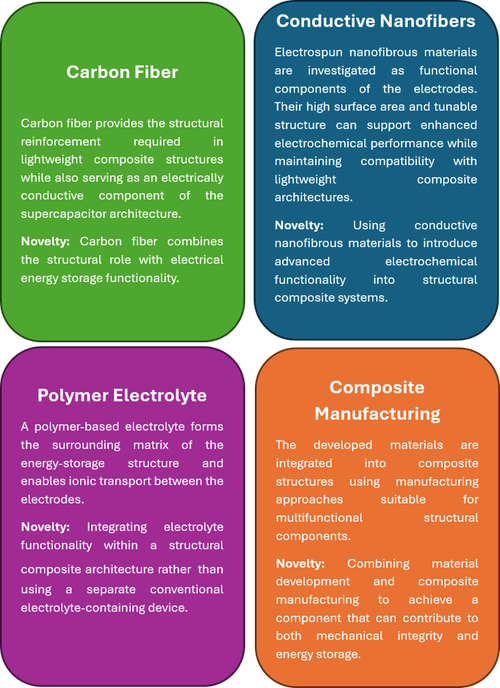
Cards contents:
How the Materials Work Together
The different material functions are combined to create a multifunctional structure:
- Carbon fiber combines the structural role with electrical energy storage functionality.
- Conductive nanofibrous materials contribute to the electrochemical functionality of the electrodes.
- The polymer electrolyte provides ionic transport between the electrodes and forms part of the structural matrix.
- The Separator separates the electrodes while allowing ionic transport within the energy-storage system.
- Advanced Composite Materials enable the integration of mechanical and electrical functions within a lightweight multifunctional structure.
Together, these components form the basis of the Nano-SuperCaps structural supercapacitor concept, where mechanical and electrical functions are integrated within the same composite structure.
From Materials to Structure
The Nano-SuperCaps approach follows a development pathway from individual material components to integrated structural energy-storage systems. Material development, electrode development, composite integration, and mechanical and electrochemical evaluation are considered together to identify suitable combinations for multifunctional applications. The technology is being investigated with a focus on achieving a balance between structural performance, electrical conductivity, electrochemical functionality, and manufacturability.
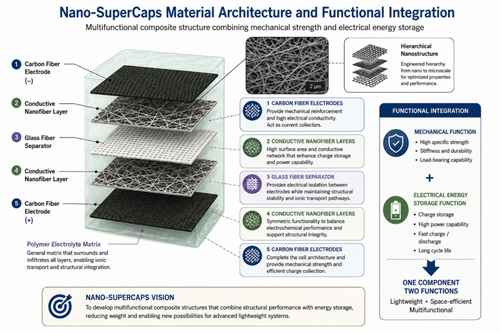
Nano-SuperCaps material architecture and functional integration
4. Applications & Impact
Potential Applications
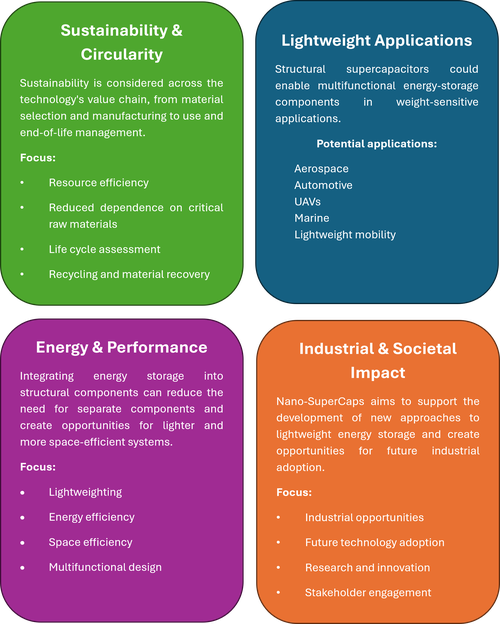
Structural supercapacitors have the potential to provide lightweight, multifunctional energy-storage solutions in applications where weight, space, and structural performance are important.
- Aerospace
- Automotive
- Unmanned Aerial Vehicles (UAVs)
- Marine applications
- Other lightweight mobility and advanced engineering applications
By integrating energy-storage functionality into structural components, Nano-SuperCaps aims to open new possibilities for the design of lighter and more space-efficient systems.
Sustainability & Circularity
Sustainability is considered throughout the development of the Nano-SuperCaps technology, from material selection and supply chains to manufacturing and end-of-life management.
The project investigates approaches that can reduce dependence on critical raw materials while exploring more resource-efficient multifunctional structures. Life cycle considerations and circularity are also taken into account when evaluating the potential future deployment of structural supercapacitors.
Societal & Industrial Impact
The development of multifunctional energy-storage structures could create new opportunities for lightweight engineering, advanced manufacturing, and integrated energy-storage technologies.
Potential impacts include:
- Development of new multifunctional composite technologies
- Opportunities for advanced manufacturing and materials industries
- Reduction of weight and space associated with separate energy-storage components
- Support for future lightweight transportation systems
- Development of new research and industrial capabilities in structural energy storage
5. Knowledge & Resources
The Nano-SuperCaps knowledge hub provides accessible information about structural supercapacitors, advanced materials, project results, and the wider policy and sustainability context surrounding next-generation energy storage.
Educational Materials
Explore introductory resources explaining the principles behind supercapacitors and structural energy storage.
- Introduction to supercapacitors
- Structural energy storage
- Nanofibers and advanced composites
- Educational infographics
6. Social Impact Assessment
The project considers the potential wider impacts of structural supercapacitor technologies through a Quadruple Helix perspective, considering:
- Social acceptance - awareness, perception, and understanding of emerging technologies
- Environmental impact - resource efficiency, sustainability, and circularity
- Economic impact - industrial opportunities, skills, and future employment potential
- Governance - alignment with European energy, climate, and industrial priorities
- Sustainability - resource efficiency and potential contribution to more sustainable energy-storage solutions